Hypermobility
Do you need help understanding and managing it?
When people use the phrase double jointed it doesn’t mean having an extra set of joints. Generally, it means that, their joints are more mobile than average and this can in some people, cause pain, postural problems, recurrent sprains / dislocations and difficulty controlling movement. I am able to offer advice and increased understanding regarding managing hypermobility.
I can help you make hypermobility part of your unique healthy movement. Over many years of clinical practice and through building close links with local podiatrists and specialist consultants, I have helped many adults and children, infact whole families, with symptomatic hypermobility and hypermobile EDS( Ehlers-Danlos syndrome)
I will tailor and carefully progress exercises and help you pace activity. Together we can explore ways of calming the nervous system which will help with the often varying nature of symptoms. This holistic approach can help reduce pain, increase strength and stability bringing ease and enhanced quality of life.

We often see people who are hypermobile in the dance and gymnastics world, as well as in many yoga studios as they tend to find it easier to achieve the moves and create the shapes required. Not all people with hypermobility have symptoms but some certainly do.
Joint hypermobility is the ability of a joint to move passively or actively beyond what is considered normal taking into consideration age, sex and ethnicity*
*(Beighton et al 1998)
Hypermobility can be genetically inherited. The genes coding for collagen, elastin and fibrillin are important in influencing joint hypermobility.
Joint hypeermobility is often under diagnosed but it’s easy to spot if you look for it. Generalised joint hypermobility is measured using a variety of tools. The most common is The Beighton scoring system.
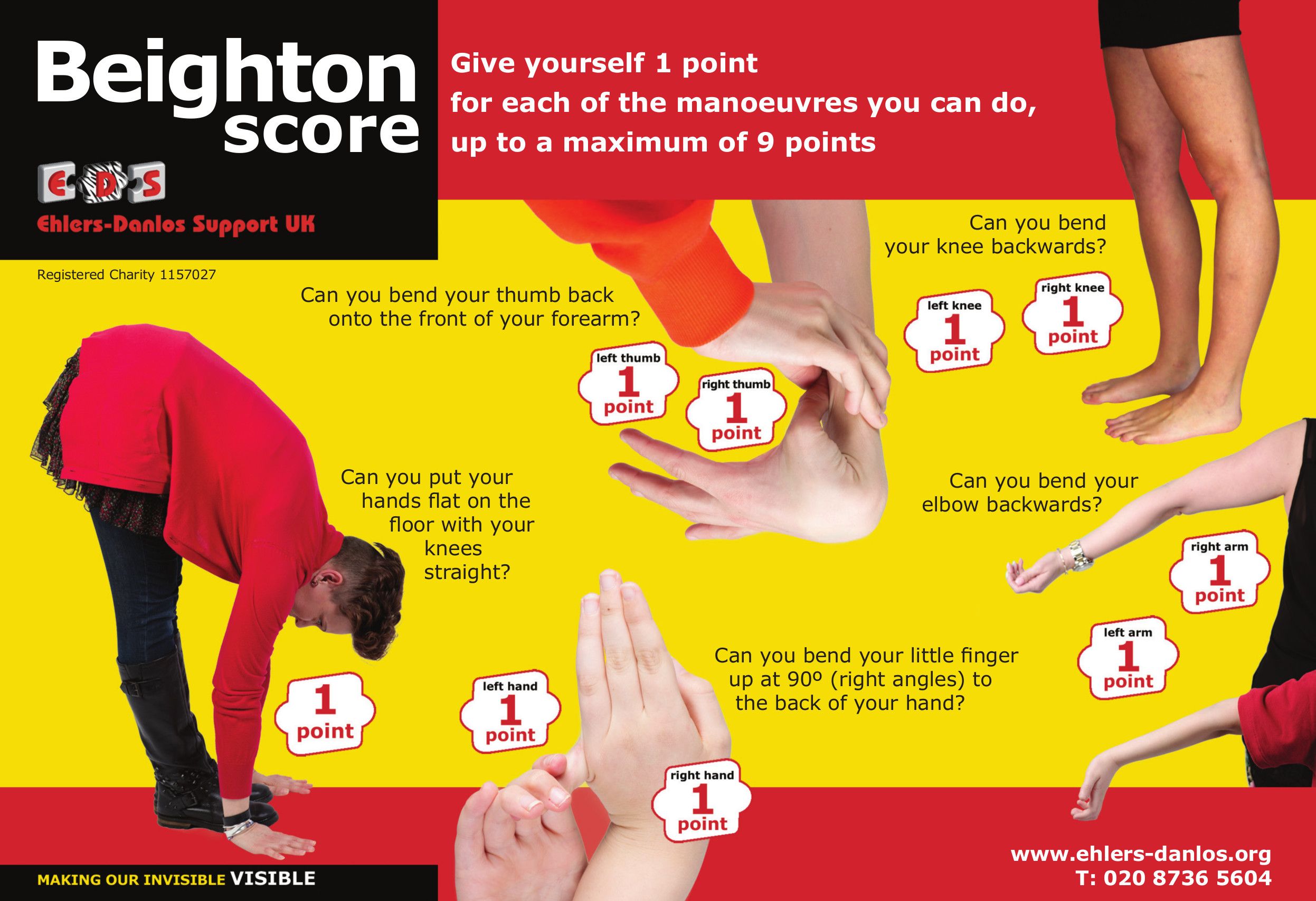
The Beighton scoring system is a popular way of classifying hypermobility.
This scoring system does have an upper limb bias but it’s a good general guide and I feel it’s best used alongside careful clinical subjective and objective evaluation.
Changing Lives Through a Whole Body Approach
Nina Robinson is a chartered Physiotherapist with clinics in Farnham and Guildford, with over 35 years of clinical experience, and believes in a whole-body approach. She has a special interest in the management of hypermobility and rehabilitation of lower limb and spinal conditions.
I am very excited to write for the community of people who live with symptomatic hypermobility and EDS. There are many equally compelling topics to address, but for today, I would like to touch on a subject that I am particularly passionate about, and one that has become very apparent to me in my experience as a physiotherapist working to help people manage hypermobility syndrome.
This community needs to be heard and understood by those around them. Many people with hypermobile EDS have consulted a multitude of health professionals, trying to get help for the symptoms they are experiencing. They often leave feeling frustrated, not understood, and passed on to the next person. It’s not uncommon for it to take years before they are diagnosed.
High rates of anxiety and depression are reported among this population. In general, I have found that hypermobility syndrome is still poorly understood within the medical sphere and the wider community.
I have witnessed the outward physical signs — the sigh of relief, the dropping of the shoulders, sometimes tears — when someone, perhaps for the first time, has felt safe to tell their story, fully describe their symptoms, and feel truly heard and seen. I have also observed changes in pain symptoms when someone feels calmer, more at ease, and genuinely validated. I’m not suggesting that I, or anyone, can fix everything.
Hypermobility syndrome is variable and unique to each person. That’s why the zebra is used as a recognised symbol for EDS.
In 2023, the first scoping review of its kind examined a large number of studies, mainly from the UK and the United States. It explored the biopsychosocial impact of hypermobility spectrum disorders in adults.
The study highlighted the importance of early diagnosis, a multidisciplinary team approach, and the need for psychological validation and early access to appropriate treatment to support health and wellbeing (Clark et al., 2023).
My heartfelt message to all of us who know and work with people with EDS and its many manifestations is this: how can we best offer a compassionate, safe, informed, and non-judgemental space?
My approach to treatment is centred around a thorough subjective assessment, where the patient is given time to speak and be heard. I approach each session with open curiosity — I believe this kind of space-holding is vital.
From there, I make an informed decision about what to assess physically. I consider the areas presenting as problematic, as well as the patient’s tolerance and comfort on the day. This may involve examination on the couch or observation of more functional movement.
I also consider how each person best processes information. I use visual and tactile feedback to support proprioception, alongside verbal cues that are patient-led and meaningful. I can also provide a written summary or video following the consultation.
My approach to the treatment and management of hypermobility is always bespoke, tailored to suit each individual.
– This article was originally published in the Winter 2024 edition of Fragile Links by EDS Support UK.